The 1980s was a time when the global situation underwent huge transformations. It was also a key time for the revolution of art history study. With the end of the Cold Wars, new changes in the global political situation began forming across the east to the west, closely followed by the rise of technology. Problems such as global warming and large-scale pollutions raised awareness on environment protection, as well as the importance of diversity in living species and culture. Simultaneously, with globalization developments came the advancements of digital products. The focus on knowledge-based economy towards the end of twentieth century quickly shifted to information economy. These movements greatly impacted the art world, depicted not only through art creations, but reflected also upon art history research methods and topics. Art history studies in higher art research education institutes provides positioning for artists and their artworks in the genealogy of fine arts; and the development of art communities in galleries provides socially acceptable value chains, an objective standard of reference, the price of each transaction, so to speak. The genealogy of fine arts and value chains plays an irreplaceable key force in the evolution of the art field, partial neither to one or the other.
Taiwan Art Gallery Archives (arTchive) has encompassed precious documentation of the past nearly sixty years. In face of changing circumstances and the demand for cultural production research in the art world, arTchive constructs a structure of Taiwan’s art gallery community step by step, from 1960 to 2020 and forward.
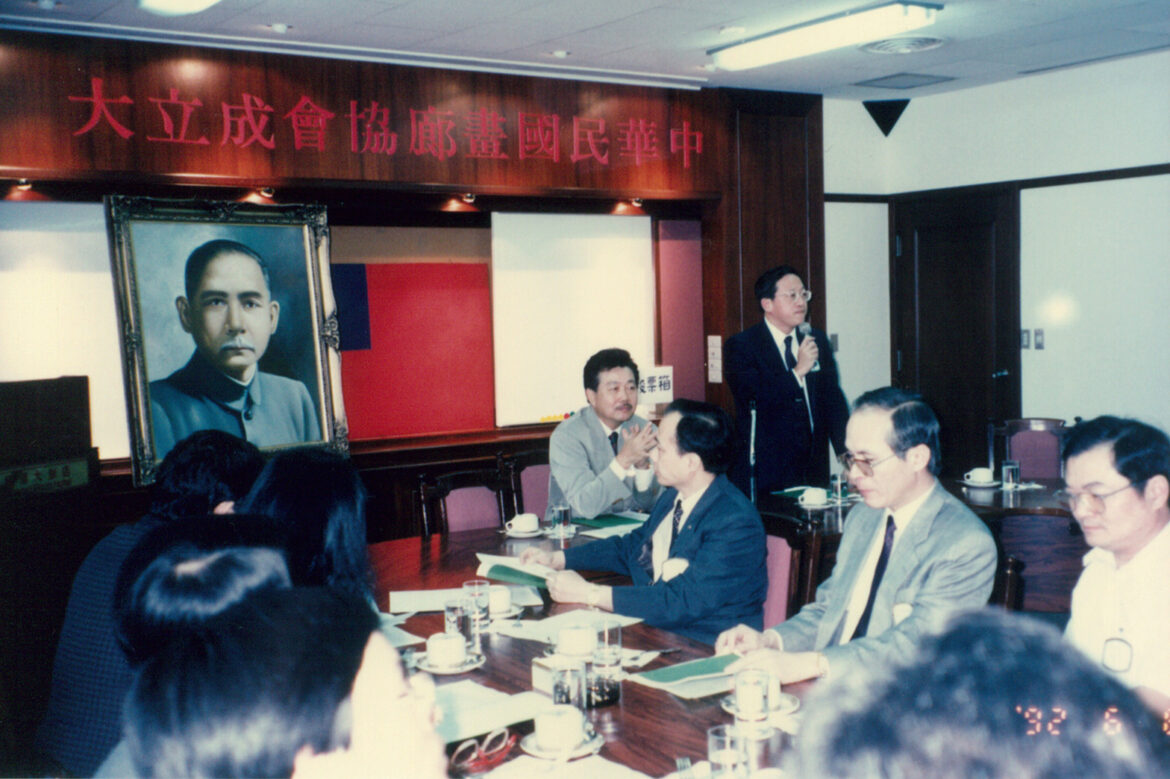
Taiwan Art Gallery Association (TAGA) was established in 1992. It is not only the earliest art gallery-centered association established in Asia, but also the first in Asia to host international art exhibitions. To meet the demand in Taiwan art industry development, Taipei Art Economy Research Centre was established in 2010, specifically focusing on art industry research and education. Completed projects include discourse on developing art industry policies, promoting the development of a stable industry structure, setting up the Institute of Gallerists, establishing arTchive research, art market data analysis, and so on.
TAGA began with 52 members, growing to 130 galleries in 2021. It is regarded as the centre of Taiwan’s art gallery industry, and the leader to the visual arts industry. Without systematic organization, the passionate history of the art gallery industry striving for Taiwan’s art environment was merely scattered accounts. Some founding members had since closed, and only 13 members remain until today. With history ever evolving, the precious experience of art contributions from these trail blazers that tug at heartstrings may gradually fade away, if not organized wisely. With the importance of systematic collection and research on “arTchive” in mind, and a sense of purpose to preserve treasured art gallery archives, the three-year project “Oral History of Taiwan Art Gallery Industry” began in 2011, conducted by Taipei Art Economy Research Centre under TAGA. The project included in-depth interviews with art gallery owners, as well as collecting diaries, letters, documents, photos, and other precious literature, as the starting point and the most important basis to arTchive. Dozens of experienced art galleries has been documented, recording firsthand art gallery operation experiences, describing the industry evolutions they had undergone, and furthermore preserving the treasured history of Taiwan’s art gallery industry.
Most documentations on Taiwan art history mainly focus on artist resumes, schools of art, and published articles. Industry-oriented archives like “History on Art Galleries” are quite rare, with many more hidden gems to unearth. For instance, most would consider that the history of Taiwan art galleries began in the 1960s. However, it was discovered in recent TAGA archives that news regarding the opening of MIN YI Gallery was published in an old local newspaper in Taichung (MIN SHENG Daily News), as early as 1957. The art gallery was established by TSAI Hui-Lang, LIN Chih-Chu, and LAI Kao-Shan. The opening exhibited artists including LIN Chi-Chu, WANG Er-Ch’ang, YEN Shui-Long, YANG Chi-Tong, CHEN Hsia-Yu, etc. This treasured piece highlights the importance of organizing the history of Taiwan art galleries, for it not only provides precious information on Taiwan art history, but also brings the history of Taiwan art galleries back to the 1950s. This is where TAGA’s sense of purpose stems from, where in the effort of building arTchive, dust-laden history was uncovered and cherished art gallery archives were preserved, so that the history of these pioneers who strove for a better art environment in Taiwan will never be forgotten.
During the process of gathering oral history from 2011 to 2014, we discovered many unmentioned artists in art history, so firsthand art gallery records exactly became important archives. Therefore, the arTchive project was launched in 2016, digitalizing existing archives to prevent accidental loss. Simultaneously, public access to online search and reading is provided in building Asia’s first gallery-oriented art history archive. arTchive is categorized into “Digital Archives,” “Project-Based Research,” and “Collections.” TAGA is first gallery-oriented association in Asia, integrating Taiwan’s art galleries and exhibitions, building an archive centered around art gallery and exhibition history. In 2017, TAGA also began collecting from its members gallery art collection publishings and exhibition leaflets, to further expand arTchive resources.
In the early stages of building arTchive, long-established art galleries played a very important role. For instance, TAGA’s founding member Apollo Art Gallery, which has dedicated its contributions to the art industry until today, collaborated with the Department of History at National Taipei University on the internship program since 2017. In 2018, Dr. CHANG Ketty of Apollo Art Gallery personally participated in the second work group meeting on The Description Principle and Method of arTchive, discussing principles, methods, and event descriptions on the metadata.
To successfully integrate internationally, meet academic requirements, and become historic study material, arTchive mainly focuses on digitalizing its platform, consulting archive experts such as
Ms. WANG Li-Chiao of the Archives of Institute of Taiwan History at Academia Sinica, Prof. LIN Su-Kan of the Department of Information and Library Science at Tamkang University, Dr. LEE Juo-Yung of the Department of History at National Taipei University, Director and Dr. CHENG Ching-Ju of Taiwan Association of Cultural Policy Studies (TACPS), and so on. arTchive follows international metadata [1]standards and archival studies[2], and partook in the Arts and Archive Platform session during “The Renaissance of Cultural Memory: Reconstruction Art Histories in Contemporary Taiwan” seminar and forum at the National Taiwan Museum of Fine Arts, publishing “arTchive: Reflections on Metadata.” These efforts are all made towards integrating arTchive internationally and sharing Taiwan’s historic resources with the world.
During data collection, research workers went through the arduous process of cross-referencing mounds of data to establish credibility. The ART TAIPEI that art galleries participated in during 1992 to 1994, for example, should be rectified to ART GALLERIES FAIR ROC. Researchers must carefully discern between the timelines of each datum and make corrections true to history.
An even more exhausting trial lies in the fact that the art gallery history began over thirty years before the digital age. Documents issued in paper had to be converted to image files, then to word files through word recognition software. These key documents have to go through the manual process of selecting, logging, cross-referencing, and rectifying. Research workers would teasingly call themselves “worker ants,” continuously and faithfully transporting, collecting, and sorting data like a relay race. Researchers rely solely on their passion for the art gallery industry to trudge on in this kind of detailed and cumbersome work. Under such industrious labor, digital archives have reached 26,260 pieces of recorded data in May of 2021, and collections have 2,703 art collection publications collected from galleries. In the effort of establishing arTchive, TAGA built a whole library themed around gallery art publishing.
TAGA’s mission and passion is embodied not only in building arTchive, but also in its actual application. To promote research projects conducted on Taiwan’s art gallery industry history, TAGA specifically established the “Scholarship for Research Projects on Art Gallery History,” in hopes to carry out industry-academia collaboration, and encourage college and university postgraduates to make Tawian’s art gallery industry history the topic of their dissertation, by further strengthening their research motive. TAGA also made Digital Archives (access arTchive at http://taga-artchive.org) and Collections (physical archives) available to public for research purposes. Two-time former Chairperson of TAGA and founder of East Gallery Mr. LIU Huan-Hsien once said, “After opening an art gallery, you will slowly began to realize that it is not just a business, because your entire life is within the gallery.” arTchive is not only a collection of precious historic data, but also a congregation of the blood, sweat, and tears by every single person in the art gallery industry, and Mr. LIU’s words sums up the collective effort towards Taiwan’s art industry.
During the course of collecting archives, some art galleries had already closed business, making it difficult to contact previous business owners, so newspapers and magazine articles are the source to firsthand proof of historic data. In those times, information was harder to obtain, so art galleries relied on news reporters to spread information on exhibitions; therefore, senior arts reporters also became eyewitnesses to the development of the art gallery history.
Consequently, arTchive began collecting news reports, entrusting Taiwan art historians such as LIAO Hsin-Tien, BAI Shi-Ming, CHIANG Po-Shin, CHEN Kuang-Yi, LAI Ming-Chu, CHENG Cheng-Chen, and so on. Information on Taiwan art galleries was collected through newspapers and magazine articles, analyzing Taiwan’s exhibition history and its development context through reports on the course of art gallery establishment, exhibition context, artists, art gallery owners, art collectors, and other related information.
With the industry ever developing, art history continues to progress, building arTchive is an unending road. These historic data, under the transporting, collecting, sorting, and cross-referencing of the “worker ants,” is the essence of Taiwan’s art gallery history. Every piece of data and every line of record is enriched with concentration and passion from art galleries and everyone in the arts industry. In the words of TAGA’s 15th Chairperson Mr. CHANG Oliver, “We hope that arTchive can be the source and nutrient to cultural resource diversity, especially during COVID. Through arTchive, we can build creativity and diversity in art assets, and form an interdisciplinary and integrated cultural platform for generations to come.”
[1] arTchive’s metadata adopts CDWA-lite 1.1 version. The research team references data requirements by the Categories for the Description of Works of Art (CDWA) and the Dublin Core (CD), to develop an archive that meets the needs of basic directory and archive management on art history
[1] During the process of collecting archives to digital presentation, the research team reevaluated the diversity of historic data behind cataloguing. File levels and cataloguing principles use “Art Galleries” as fonds, and the archive continues to grow with art gallery industry developments.